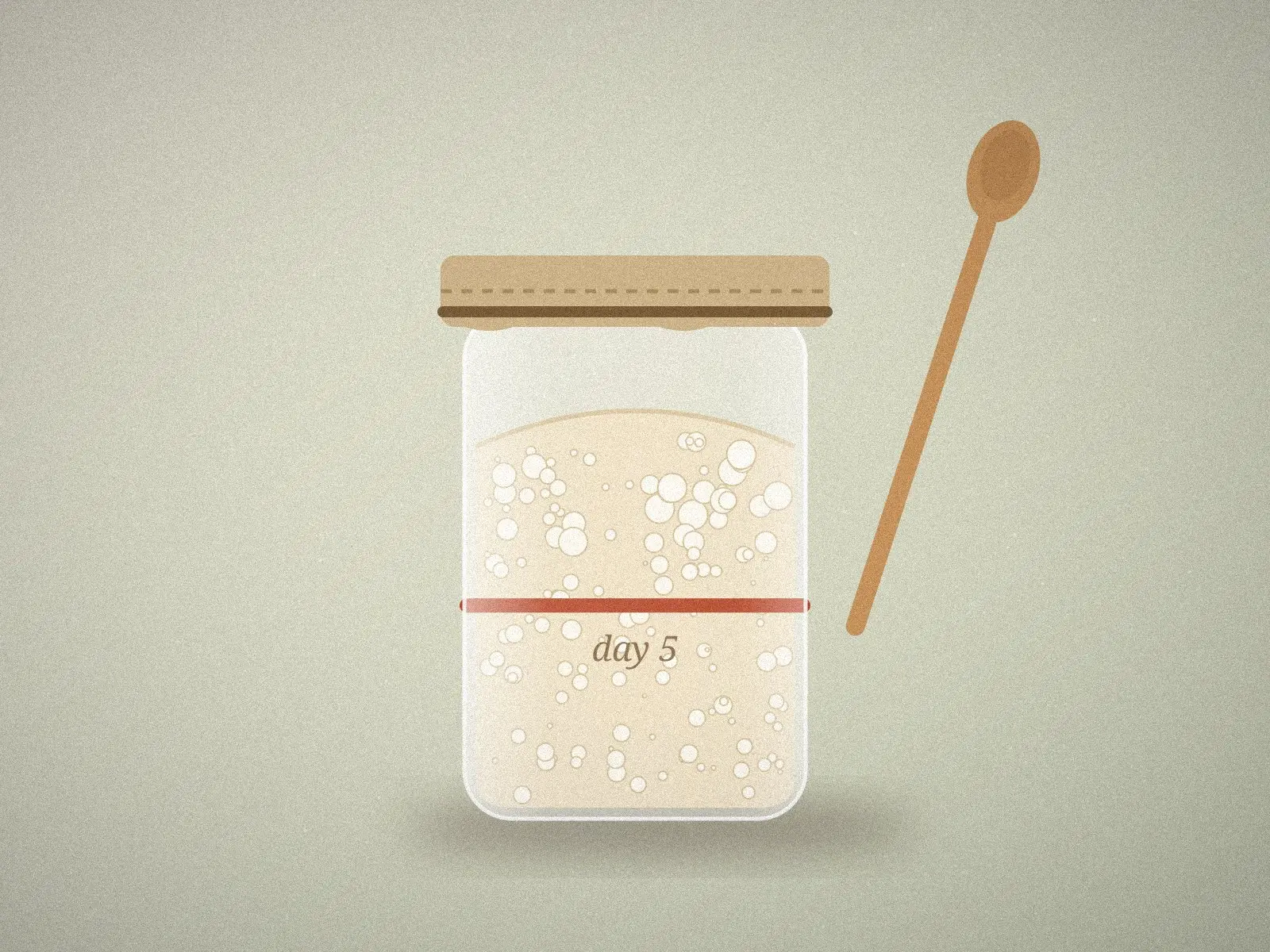
My starter is called Gerald. Gerald spent the whole of August at the back of the fridge behind a jar of capers while I was away, and when I came home he had a grey layer of liquid on top and smelled faintly of a bus station.
This is normal. A neglected starter is not a dead starter. Five days of regular, slightly fussy feeding will almost always bring one back.
Day by day
| Day | Ratio (starter : flour : water) | Feeds | What to expect |
|---|---|---|---|
| 1 | 1 : 2 : 2 | 1 | Little or nothing. Smells sharp. |
| 2 | 1 : 3 : 3 | 2 | A few bubbles at the sides. |
| 3 | 1 : 4 : 4 | 2 | Rises 25–50%, falls early. |
| 4 | 1 : 5 : 5 | 2 | Doubles in 6–8 hours. |
| 5 | 1 : 5 : 5 | 2 | Doubles in 4–6 hours. Ready. |
Use 20% whole rye or whole wheat in the feeding flour. The extra minerals and wild yeasts on the bran give the culture something to get excited about.
The rubber band trick
Put a rubber band around the jar at the level of the starter right after feeding. It sounds childish. It is the single most useful tool in my kitchen, because it turns “it looks a bit bubbly, maybe?” into a number.
A starter that doubles predictably is worth more than a starter with a clever name.
Every baking forum, eventually
When to worry
- Pink, orange or fuzzy patches: that is mould or bacteria you do not want. Throw it out and start again.
- Grey liquid (hooch): harmless alcohol. Pour it off for a milder starter, stir it in for a sourer one.
- Smells like acetone: hungry. Feed it more often or at a higher ratio.
Gerald was doubling in four hours on day five. He is now back in the fridge, fed weekly, and I have learnt nothing.


Leave a Reply